rss
twitter
    Find out Geology in Art book, Follow Me :)

Wednesday, April 28, 2010

A GeoArt exhibit: interview with Greg Wessel

Geologic Art is a collective term for artistic phenomena in which geology brings its own aesthetic and conceptual baggage.
  Baucon (2009). Geology in Art


Geologic Art (GeoArt) cannot be regarded a style or a movement; nevertheless, it is a definite, peculiar field as it records the work of “geologic thinkers”. From the layers of Leonardo da Vinci to the fossils of Allan McCollum, “geologic thinkers” traversed centuries and continents to express the emotional charm of the Earth. Despite its importance and diffusion, GeoArt lacks of spaces in which geoartistic objects meet an audience.
In this scenario, there is an art show which is singularly significant in developing and collecting works of Geologic Art: “Geo sapiens, The Fusion of Geology and Art”. Geo sapiens is the first-ever show dedicated to Geologic Art and it is hosted by the Two Wall Gallery (Vashon, Washington, U.S.A.). The first edition of Geo sapiens featured the work of nearly 50 geoartists from across the world (US, Canada, the UK, France, Slovenia, Australia, New Zealand, Japan) and expressed geology in art through a plethora of media and styles.
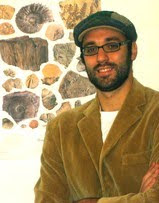
The upcoming second edition (announced for September, 2010) led me to contact Greg Wessel (figure on the left), the curator of the exhibit, and ask him about Geo sapiens, a breakthrough in the universe of GeoArt.

1.    How was the Geo sapiens exhibition born? What was the catalyst?

I’ve been working as geologist since finishing my MS in 1977, and have done a little art of my own of various sorts (stained glass, printmaking) over the years.  Every so often, I’d stumble across another geologist who also did some kind of art, including music and dance.  For a long time, I’ve thought that there had to be many more geologists around who had a second creative outlet, perhaps because we tend to be creative people during our day jobs.  At the same time, I sensed a decline in the artistic part of being a professional geologist, such as the decline in geologic mapping (so basic to our profession) and more dependence upon computer models and computer assistance. 

A couple of years ago, I volunteered to co-curate a small gallery (Two Wall), which really is just a volunteer group dedicated to having fun and working with art, but not dedicated to making money.  Shortly after taking over, it occurred to me that there had to be enough other artistic geologists out there to make a good show, and to highlight both the creativity in the profession and our connection with the natural world.  The main problem would be finding them.

2.    What inspired you to pull together this exhibition? What were your goals?

I think I was inspired by my wife, Margaret, who loves to dance and who also loves to go rock collecting (she’s an igneous petrologist by training).  I presented the idea of a geo-art exhibit to her, and she challenged me to try it.  My goals were simple:  to connect with other geo-artists and create a venue where they could exhibit together, creating a group exhibit centered on geologic features and principles.

A virtual visit to Geo sapiens: the geoartists John Jackson and Elisabeth Hill. On the backround a colorful artwork by John Jackson (if you want to know more about him, see this past issue of Geology in Art)

3.    How would you describe the organization of the exhibit itself?

Geo sapiens was somewhat of a “dog’s breakfast” of geology-related art works.  We had oils and acrylics, water colors, etchings and linocut prints, pencil drawings, pen and ink drawings, fiber art, carved rock sculptures, a stained glass window, a lamp made out of thin slices of quartzite, photographs, digital manipulations, cartoons, and several works based on topographic maps.  We even had some poetry, handmade furniture, and mosaics made from rock slices that incorporated fossils and amazonite crystals.  The common thread was that all of the artists had some kind of background in the earth sciences and a great appreciation of geology and the natural world.  You could see it clearly in this collection. 


4.    How did you select the artists involved?

The original idea was to limit participants to those who were working earth scientists or had a degree in geology of some kind, but it quickly became clear that there are a lot of talented students out there and it made sense to be as inclusive as we could, so we advertised it as open to professionals and students, and then we defined “student” rather loosely.  Of the nearly 50 participants, better than three quarters were working scientists or engineers.  The rest were college students, part-time students, or retired.  Employment status was not important.

Space was a problem for us, and remains so for Geo sapiens II, so we limited the number of pieces each artist could show, and we were unable to include everyone.  That is probably my biggest disappointment, that we ran out of space and could not show everyone’s work.  I really didn’t have to choose between “good” and “bad” art...it was ALL good!

Devonian Dash by Susan Judy. This sculpture tells a geologic story with geologic materials: a trilobite and its associated trace.

5.    Which were your sensations and suggestions working in-between Geology and Art?

I think this exhibit made it clear to all of the people who participated that they should be more artistic when doing geology and that they could rely more on geology to give them inspiration for their art.  You can put the two together at both ends.

6.    Can you walk us through some of the show's highlights?

I would refer you to our web site (www.twowallgallery.com, click on Archives) where you can see almost all of the works we exhibited.  My father (Ralph Wessel) photographed all of the works, and some of the artists, and my son (Nathaniel Wessel) created the web site. 

I love everything in the show, but I do have a few favorites.  One is the large painting of western Washington and the Cascades (from high up) by Dee Molennar.  Dee is a famous mountaineer who has climbed Mt. Rainier over 100 times and other mountains including Denali and K2.  He is now in his 90s and still really active.  When we went to get the painting for the show, he was up on his garage roof fixing it.  Always the climber, Dee.  Another favorite is a painting by Sylvie Pinard that stylistically represents river meanders.  I love that one.  And there are two incredible rock sculptures by Bill Laprade and a lamp made of thin slices of quartzite by Al Dahlstrand.  Susan Judy’s mosaics are also amazing.  And the two felted fabric sculptures by Linda Hope Ponting...oh my gosh...and the paintings by John Jackson from Australia (who actually came for the opening).  There are just so many great works that you have to check the web site.

Dee Molennar: geologist, mountaneer and artist.

7.    Which themes stood out most consistently?

There really was only one main theme, and that was a fascination and a love of the beauty and complexity of the natural world.  There was also one smaller theme, present in a few of the works, and that was of sadness and loss because of pollution and the destruction of the environment that we treasure.  In fact, those two themes embody the contradiction in geology that exists for me personally:  We love to work in the field studying and treasuring the landscape, but many of us wind up working for mining or petroleum companies who have a vested interest in damaging those things that we so treasure. 
Left: Elisabeth Hill, Volcanic Seed Pod
Right: Geoartists at Geo sapiens: Dianne Noseworthy.
 
8.    Could you add something about the quantity and diversity of artworks involved?

Quantity...our little gallery was packed.  And diversity...yes, lots of media represented, and lots of different representations of how much we, as geoscientists, are fascinated by and respectful of the Earth.

9.    What do you think is the commonality between the artists collected and what is the main differentiating quality?

The commonalities I think I have already described.  The differences...well, each of the geo-artists came from a slightly different background.  Be it a different home country or a different specialty.  You can see these differences in their works.  The art is both universal and personal.

10.    How can someone who's not a geologist understand Geo sapiens?

There were only a few pieces in our collection that needed a little background information, and we provided that.  It’s amazing to me how basic and understandable geologic ideas are to everyone, but schools these days teach basic geology at several grade levels and lots of people vacation at places like the Grand Canyon and Mt. Rainier, where you can’t help but learn geology.  Here in the Pacific Northwest, most people have a basic knowledge of volcanoes, earthquakes, and tsunamis, and have experienced at least one of the three.  Still, art is supposed to make you think, isn’t it?

Geo sapiens featured several sculptures, such as this inspired view of plate tectonics (Subduction by William Laprade). 

11.    Geo sapiens was exhibited at the Two Wall Gallery, which hosted other shows of Geologic Art (i.e. Excuse My English: Layering on the Light Side by Stephanie Lasalle).  How would you describe the role of the Two Wall Gallery within the geoartistic world?

I wish I could say we occupy some kind of prominent position, but there are a lot of folks who would argue that we’re just a small gallery with a geologist for a curator.  And I’d be one of the people saying that.  Anyone else can do this; you just need a good venue and a lot of advertising.  In fact, I’m convinced that geo-art shows could be held all over, even simultaneously, without running out of interest.  There are enough artistic geologists, for example, to easily fill two or three regular shows in the US and Canada, probably at least two in Europe, and others elsewhere.  Some of our Geo sapiens exhibitors have offered to help host satellite shows, but none of those have come together yet.  I’d love to help put together a show in Europe, for instance, and we have an Australian who wants to do one down there.  You just need to find a gallery space, and off you go!

Left: Méandres bruns by Sylvie Pinar.
Right: Trilobite Coquina by Ancil Meacham.

12.    What does Geo sapiens tell us about Geology that many people might be surprised of?

I think it tells us that geologists as a whole can make connections and understand realities that many people cannot see in their day-to-day existence.  We’re good at seeing the big picture, and part of the reason we’ve studied the natural world is because we so love being in it.  Putting those two characteristics together can make for some impressive art.


13.    Geo sapiens II has been announced for September, 2010. What are the biggest challenges facing it?

Organization and marketing.  As with Geo sapiens I, the trick is to get the word out to geologists that we’re doing this.  Geologists typically don’t see calls for artists, and most artists are not geologists, so the problem is figuring out ways to connect with those geologists who ARE artists.

Stephanie Lasalle is an abstract painter who is inspired by the patterns and microstructures of rocks and minerals as viewed through the microscope. Geo sapiens exhibited her vivid Who Said Gabbros Didn’t Have Heart.

14.    Is there a possibility of the exhibition touring?

The most likely way to start going on tour would be to coordinate an exhibit with a professional society annual meeting, such as in my case the Geological Society of America or the Geological Society of Canada.  Some of the societies already do similar things.  The GSA, for example, typically has a photography exhibit (which always has amazing entries) but they don’t curate collections of other media or fine art.  What I find really interesting is that the National Speleological Society has several art salons that they organize along with their annual meetings.  One is just about designs for insignias and patches.  Apparently, cavers are really interested in art!  It’s funny that I used to be a caver myself. 

But the real problem with going on tour is the shipping expense.  I had originally hoped that we could go on tour, but I quickly learned that although there are plenty of people around the country who would love to see an exhibit like ours, getting the money together to take the show on the road was not going to be easy.  We still haven’t figured that out.  If we could find a source of funding and hook up with a good museum (Los Angeles, Denver, New York, Smithsonian, are you listening?) or several good galleries, then we’d have it made.

15.    Is there an audience for Geologic Art?

I can answer that with two words:  YOU BET!  Everyone loves it.  There is absolutely no doubt about that.

Geosapiens: everyone loves GeoArt!


NOTE: All the pictures of this issue come from http://www.twowallgallery.com/geosapiens.html. I suggest you to visit the website, there you will find a comprehensive gallery of Geo sapiens!


Friday, March 26, 2010

Per Kirkeby: Geology’s abstract landscape painter

Towards a map of Geologic Art: the tag cloud of my book 'Geology in Art' (built with http://www.wordle.net/).

When I wrote ‘Geology in Art’, I was astounded by the variety and complexity of the interrelationships between Geology and Art. Music, literature, painting, sculpture… The world of Geologic Art (GeoArt) is vast and underexplored.

At present day, my research aims to trace a map of the GeoArt phenomenon, but many areas are still unexplored. "Hic sunt leones!" I have to thank Anette Petersen for drawing my attention on Per Kirkeby, one of the most internationally acclaimed Danish artists.


Per Kirkeby, Weltuntergang.

I must be sincere now. When I initially approached Kirkeby’s artwork I asked myself: “where’s the geology there?”. Then I started to look better. Those abstract patterns had something familar, although I was not able to discern clear visual references to the geological world. Nevertheless, I knew that those color splashes had ‘something’ geologic. As a geologist, I saw those pattern in the field, so I thought:

It isn’t rock but it is rock.
It isn’t a mudcrack but it is a mudcrack.
They aren’t layers but they are layers.

This is Kirkeby’s Geology.


The structural organization of Kirkeby's Brett Felsen recalls layering. The work was displayed at the Tate Modern Gallery, which hosted a monographic exhibition of the artist in 2009.


Cross-bedding in Middle Old Red Sandstone on the Isle of Bressay, Shetland Islands. Compare it with Kirkeby's Brett Felsen. Photo by Anne Burgess

Now I feel Kirkeby’s artworks as patterns of visual geology. My idea is supported by the artist’s biography. He is a geologist and earned his master's degree in arctic geology, participating to expeditions to the Arctic and Greenland. With the words of artfacts.net: “Vertical structures predominate in these paintings, forming new associations with the landscape motif which has long fascinated the artist. Indeed, ideas about landscape, sedimentation, and layers are key elements in Per Kirkeby's art rooted in the artist's early geological studies at university.” In my opinion, the structure of Kirkeby’s works seems to follow the same constructional ‘rules’ of many geologic elements. This is a very personal (and biased) idea, but these rules could be the self-similarity of fractals. Fractal organization is very common, either in geological structures or in art (you find here a paper about geology and fractals).

Per Kirkeby, Flight to Egypt.

When I saw Kirkeby's 'Flight to Egypt' I thought to through-bedding, then my mind went to thin sections (illustrated). Thin sections are thin slivers of rock, usually examined by geologist under the light of a polarizing microscope.


It appears that Kirkeby’s visions originated by the observation of geology in the field and geology is the ‘magic fluid’ permeating Kirkeby’s aesthetic universe. If somebody would ask me to frame Kirkeby’s role in Earth Sciences, I would answer:

“Kirkeby is Geology’s abstract landscape painter”.


Wednesday, March 10, 2010

A Paleo-Road Trip through Art: Cruisin' the Fossil Freeway

Ray Troll is one of my favorite paleo-artists, thanks to his very peculiar style. Colorful vivid, ironic, dreamy: Troll's artworks have a unique, unmistakable appeal. Recently, Troll and Kirk Johnson organized an exhibit with a weird name: Cruisin' the Fossil Freeway. It makes no surprise that I decided to investigate.

I discovered that 'Cruisin' the Fossil Freeway' was presented at the Burke Museum, displaying a sort of paleo-road trip through American West. What an engaging theme! Unfortunately, I live in Europe, so it is quite difficult to visit the show. What a pity!


A look at artist Ray Troll's artistic process throughout the creation of the Cruisin' the Fossil Freeway exhibit, on view at the Burke Museum of Natural History and Culture.

Nevertheless, I found a possibility. Ray Troll and Kirk Johnson authored a book with the same name: it is 'Cruisin' the Fossil Freeway: An Epoch Tale of Scientist and an Artist on the Ultimate 5,000-Mile Paleo Road Trip'. It follows the travels of a paleontologist and an artist driving across the American West in search of fossils. The book is filled with Troll's art! Although only this makes the book a must-have, there is much more. 'Cruisin' the Fossil Freeway' is not a coffee-table book, it is a sort of illustrated diary. The story is presented with a very engaging narrative, full of anectodes and curious facts. It's a pleasure to read it!
'Cruisin' the fossil Freeway' recalls the spontaneous road trips of Kerouac and his friends across mid-century America. More in detail, I thought of Kerouac's 'On the Road' when I read of a 'paleontologic' backstage with Ziggy Marley!


Kirk Johnson, PhD, chief curator at the Denver Museum of Nature & Science talks about his award-winning book, Cruisin' the Fossil Freeway.

Curiosities apart, the book is an amazing road-trip travelogue with an impressive visual part, including not only Troll's illustrations but also many 'on the road' photographs.

If you like adventure, fossils or art, then you will enjoy this book!


Ray Troll authored also a paleontologic song: this is the 'Devonian Blues'! If you liked the music, you can't miss Troll's 'Cannery Girl'!

Tuesday, March 9, 2010

Diplodocus in Art

Heinrich Harder, Diplodocus (1916). Although the idea of sauropods is quite changed from then, the work of Harder is still a masterpiece of paleo-art.

Diplodocus is a sauropod dinosaur which lived in what is now western North America at the end of the Jurassic period. Alongside with Tyrannosaurus, Diplodocus is one of the most famous and much-depicted dinosaurs.
His role in popular culture is partly related to the industrialist Andrew Carnegie, who donated many mounted skeletal casts to potentates around the world at the beginning of the twentieth century. Thanks to him, people worldwide familiarized with Diplodocus.
Carnegie's project drew much public attention in Europe and the German satirical weekly Kladderadatsch (or 'Crash') devoted a poem to the dinosaur:

[...] Auch ein viel älterer Herr noch muß
Den Wanderburschen spielen
Er ist genannt Diplodocus‚ und zählt zu den Fossilen
Herr Carnegie verpackt ihn froh
In riesengroße Archen
Und schickt als Geschenk ihn so
An mehrere Monarchen [...]
The translation is:
[...] But even a much older gent
Sees itself forced to wander
Goes by the name Diplodocus
And belongs among the fossils
Mr. Carnegie packs him joyfully
In giant arcs
And sends him as gift this way
To multiple monarchs.

Successively, the artist Winsor McCay's based his animated character 'Gertie' on sauropod dinosaurs (i.e. Apatosaurus and Diplodocus). Although not the first animated film, 'Gertie the Dinosaur' was animated character with an appealing and well-defined personality. The first presentation of the film was at the Palace Theater in Chicago on February 8, 1914. The performance consisted of McCay interacting with Gertie, following the tradition of vaudeville theatrical shows.
The animator-actor would stand on stage in front of the projection screen, dressed in a tuxedo and wielding a whip. He would call Gertie and instructed her to perform various tricks, similar to a circus act.
He would appear to toss an apple to her — McCay palmed the apple while Gertie caught an animated copy of it. For the finale, McCay disappeared behind the screen just as a cartoon version of him climbed onto Gertie's head and rode off.

Winsor McCay picked up by Gertie!


Gertie's poster. 'She's a scream!'


Here is the movie of Gertie the Dinosaur. The author - Winsor Mc Cay - also created the newspaper comic strip Little Nemo in Slumberland.

Gertie was named #6 of the '50 Greatest Cartoons' of all time in a 1994 survey of animators and cartoon historians.
Sauropod dinosaurs appear also in Centennial, a novel by James Michener that traces the history of the plains of northeast Colorado from prehistory until the early 1970s. In most recent times, the Dutch electronic music trio Noisia composed a song named 'Diplodocus'. Check it out!


'Diplodocus' by Noisia.

Monday, March 8, 2010

The Ultimate Dinosaur

When I was just a paleo-enthusiastic kid I recieved "The Ultimate Dinosaur" as a present. It is a book which alternates essays written by paleontologists, short stories authored by science fiction writers, and artworks created by first-class illustrators. The book mixes coherently very different languages to describe prehistoric life: science, literature and visual arts. A great concept.
I will take three authors as an example of the multi-faceted nature of the book: Phil Currie (paleontologist), Ray Bradbury (writer) and William Stout (visual artist).
Phil Currie. 'The Ultimate Dinosaur' includes a scientific essay by Philip Currie: 'Migrating dinosaurs'. Currie is a Canadian paleontologist researching on dinosaurs, with particular interest for theropods and the origin of birds. He helped to describe two of the first dinosaur specimens with feathers, indicating that many dromaeosaurids were feathered.
Intriguingly, Currie is a life-long science-fiction fan, and fan of the works of Edgar Rice Burroughs. Geology and Art, again.

Philip Currie, paleontologist..

Ray Bradbury. Probably my favourite story from 'the Ultimate Dinosaur' is 'Besides a Dinosaur, Whatta Ya Gonna Be when you grow up?', authored by the noted sci-fi writer Ray Bradbury. He is a prolific writer and his works includes classics such as 'Farhenait 451' and the 'Martian Chronicles'. Bradbury attributes his lifelong habit of writing every day to an incident happened in 1932. Mr. Electrico, a carnival entertainer, touched him on the nose with an electrified sword, made his hair stand on end, and shouted, "Live forever!".
It was from then that Bradbury wanted to live forever and decided his career as an author in order to do what he was told: live forever. It was at that age that Bradbury started his interest for magic. Curiously, Bradbury was a close friend of Charles Addams, an american cartoonist who invented the characters known as 'The Addams Family'.
Ray Bradbury has long had a fascination with dinosaurs, as demonstrated his stories and poems about the mesozoic beasts. Some of Bradbury's stories on dinosaurs are included in the volume 'Dinosaur Tales'.


William Stout.
Among the artists who illustrated Bradbury's 'Dinosaur Tales' there is William Stout, which also provided some works of art for 'the Ultimate Dinosaur'. Indeed Stout is either a fantasy artist and a paleo-artist, moving without difficulty between the two worlds.

His double otlook can be seen in his numerous incursions outside the 'traditional' 2D-art. For instance, he worked on over thirty feature films, including both 'Conan' and Gulliermo del Toro's 'Pan's Labyrinth'. His expertise with paleontology is witnessed by his role in the computer-animated movie 'Dinosaur' (Walt Disnet Pictures; he was the character designer).
It is worth to note that eleven Stout paintings were selected for the traveling exhibition 'Dinosaurs Past and Present', an important group show depicting the history of paleoart.
Stout is also an outdoor enthusiast.
In Antarctica he climbed Mt.Erebus, made several dives beneath the ice, camped in the dry valleys, and produced over one hundred painted studies on Antarctica's wildlife. His experiences resulted in several exhibitions: 'William Stout's Visions of Gondwana - Past and Present Life in Antarctica', 'Dinosaurs On Ice - William Stout's Antarctica', 'Dinosaurs, Penguins & Whales: William Stout's Antarctica'.


The multi-faceted interests of William Stout recall the personality of Charles Willson Peale, an American painter born in 1741. Peale had a great interest in natural history and organized the first U.S. scientific expedition in 1801.
He founded the Philadelphia Museum, later renamed the Peale museum. Notably, the museum was among the first to adopt Linnaean taxonomy. Peale's museum was among the first to display mastodon bones and the artist also illustrated a paleontological excavation of a mastodon.

Charles Willson Peale, Exhuming the First American Mastodon (1806).

Thursday, March 4, 2010

Paleontologic inspirations in James Cameron's Avatar

Like many other sci-fi enthusiasts, I saw James Cameron’s blockbuster film Avatar.
My opinion is twofold, divided between two aspects of the movie: filming and watching it.

Filming Avatar.
Cameron invested substantial resources in creating a revolutionary filming framework and probably set a reference point for the technology of filmaking. For instance, Avatar introduced a very efficent virtual camera system, displaying an augmented reality on a monitor. Thanks to this technological advance, the director can see the actor's virtual counterparts into their digital world in real-time.


Watching Avatar.
Here Avatar is less revolutionary. The movie is aesthetically impressive, but the final result is fully comparable to the last-generation computer graphics. Outstanding, but nothing new. Similarly the the 3D glasses represent a juicy old-fashioned technology but they are not critical to appreciate the elaborate visuals. Despite the significant hype raised, Avatar is not a breakthrough in the aesthetics of moving images.
As most of the movies, Avatar isn't only visuals. Indeed I greately appreciated the themes, revolving around a sense of ecological awareness. Avatar criticizes the environmental and social effects of imperialism, coming out at the right moment of the development of human civilization.
Unfortunately, the themes are developed through an extremely linear plot. After the first 30 minutes you know already all the movie. Nothing unexpected happens and there is the persistent impression to have seen something like that before. As many people said, Avatar is nothing more than 'Dances With Wolves in space'.
Avatar is a phenomenon you can't ignore, entertaining and done with extraordinary expertise. Nevertheless, it is definitely not a masterpiece.


Paleontology in Avatar. You might ask why I dealt about Avatar. Isn't this a blog about Geology and Art?
The answers are quite subterraneous, and they regard the fictional biology created by Cameron.
Avatar witnesses an enormous effort into bringing a fictional biological world to life. The result is convincing, although many creatures are modeled closely on familiar animals.
Under this point of view, Avatar is an eye-catching interpretation of how evolution might toss up on another planet. Paleontology is one of the strongest evidences of evolution, therefore I started to look for any paleontological references in Avatar.
Many creatures are obviously dinosaur-like or pterosaur-like, but I didn't find any explicit reference to precise prehistoric animals. Consequently my quest could finish without a result, but then I found the words of Wayne Barlowe, one of the creature creators of Avatar:

"
I was influenced by manta rays and skates – sea life motifs were prevalent in my thoughts at the time – when it came to my initial concepts. Their lines informed everything from wings to head profiles.
And, yes, being a huge paleontology buff did make me think of the vast variety of relatively little-known pterosaurs and plesiosaurs with their many, unique aerodynamic and hydrodynamic solutions."

Bingo! This demonstrates the origin of the reptile-like flying critters from planet Pandora, coming straight out from geologic times. In conclusion, Avatar is neither a paleontologic movie or an example of geologic art, but it shows how fossils can inspire modern artists.

The Thagomizer

The thagomizer is an arrangement of four to ten spikes on the tails of certain dinosaurs, of which Stegosaurus stenops is the most familiar. It is believed to have been a defensive weapon against predators, although some researches propose a display function only.

Stegosaurus by Heinrich Harder, a paleoartist active between 19th and 20th century. Note the spike arrangement on the tail: it's the Thagomizer!

The term "thagomizer" comes from a 1982 comic strip: the Far Side by Gary Larson. The strip shows a caveman professor discussing about the spikes on the tail of Stegosaurus. The professor explains to the audience that the spikes were named "after the late Thag Simmons" (Thag Simmons is a fictional caveman from Gary Larson's comic).

"Now this end is called the thagomizer...after the late Thag Simmons."

The paleontologist Ken Carpenter picked up the term and used it when describing a fossil at the Society of Vertebrate Paleontology Annual Meeting in 1993.
Thagomizer has since been adopted as an anatomical term!

The author of the comic strip has a background in Life Sciences, which explains his frequent use of animals and nature in the comic. For this reason too, he is well aware that dinosaurs and humans did not exist in the same era. Indeed he suggests that "there should be cartoon confessionals where we could go and say things like, 'Father, I have sinned – I have drawn dinosaurs and hominids together in the same cartoon.'"

The Thagomizer is not the only scientific term brought by comics. A nice example is given by a strip from "Calvin and Hobbes", criticizing the naming of the Big Bang as unevocative of the wonders behind it. The strip coined the term 'Horrendous Space Kablooie', which has achieved some popularity among the scientific community, particularly in informal discussion.
What about the suggested alternative to Tyrannosaurus rex, 'monstrous killer death lizard'?

Friday, February 26, 2010

Geology in Art Special Review: Walking with Dinosaurs - The Arena Spectacular

Visual artists often depict reality through painting, but theatre offers the chance to imitate reality in form and movement (see Taddei et al, 2005). For this reason, machines are used since the origins of performance arts.

For instance, Horace used the expression "deus ex machina" when referring to the conventions of the Greek tragedy, where a crane lowered actors playing gods onto the stage. In more recent times, many of the most important engineers and artists of the Renaissance were often involved in making machines and stage settings for the theatre. Leonardo da Vinci is no exception. For a festival in Lyons, Leonardo designed a lion which after it advanced, opened it chest spilling lilies onto the stage.

Tonight I have seen the same visual potential in the mimetic representation of the Mesozoic given by ‘Walking with Dinosaurs – The Arena Spectacular’. It is a live adaptation of the award-winning BBC TV series ‘Walking with Dinosaurs’ and it features tens of mechanically-operated dinosaurs. Originated in Australia in January 2007, it toured North America in 2007, 2008 and 2009. An Asian tour is being scheduled, while it currently travels through Europe. More than 4.4 Million people have seen the show worldwide.

I went to the Assago Forum (Milan) for seeing this live performance show. It’s a 'Geology in Art Special Review'!

Spectacular. This is the first word that came into my mind after the début of a 10 meters long Plateosaurus, moving realistically and interacting with the stage. After that, it was just a series of “whoa!”. It is amazing to see a 17 meters long Brachiosaurus, staring at you from more than 10 meters of height. These are only two of the eight huge hydraulically-operated dinosaurs (Stegosaurus, Allosaurus, Ankylosaurus, Torosaurus, Tyrannosaurus rex), accompanied by a flying reptile (Ornithocheirus) and five suit dinosaurs (3 Utahraptors, baby T-Rex, Liliensternus).

The gigantic dinopuppets will make you feel that you are looking at real dinosaurs. I also enjoyed a lot the flora, recreated by tens of inflating elements decorated with psychedelic colors.

Engaging narrative. The entire show is narrated by a paleontologist, which is necessary to explain the scientific details of the show. This is a very risky choice, because the presence of a human on stage could suggest an erroneous coexistence of humans with dinosaurs. Fortunately, the show is perfect even under this point of view. When dinosaurs are acting, the actor-paleontologist occupies always a marginal place. Moreover, the actor-paleontologist often reminded explicitly “dinosaurs and humans never lived together”. Great!

Technology. The technology which animates the dinosaurs is amazing. But there is more. Indeed the show uses both live and recorded video to enhance the scenes. Two screens shows the details of the arena and a huge cinematic scope plays recorded video for creating an immersive experience. Dramatic lighting, growls, symphonic music underline the performance.

Science. "Nothing in Biology Makes Sense Except in the Light of Evolution" is a 1973 essay by the evolutionary biologist Theodosius Dobzhansky. Evolution is one of the most fundamental scientific discoveries of our time, and gives precise answers to the basic human questions “Where Do We Come From? What Are We?”. Evolution is the unifying force in modern biology.

The show promotes the understanding of evolution, dealing with themes such as coevolution, arms race, competition and natural selection. In one word: this is a wonderful educational experience!

Obviously, the main focus of the show is paleontology, which is presented in a very appealing way, discussing also about paleoichnology (the study of trace fossils). This discipline is almost ignored by the general public, so I was very happy to see the actor discussing about the importance of fossil footprints, burrows and coprolites.

In conclusion, I had an enthusiastic impression of “Walking with Dinosaurs – The Arena Spectacular”: it’s the creative show of evolution and paleontology!


Thursday, February 18, 2010

Paleoart between tradition and innovation: Juan de Santiago

I just visited "the Prehistoric Swamp" and "the Volcano Ghost", two blogs maintained by the paleoartist Juan de Santiago. He is a promising paleoartist working with traditional and digital technologies. Take a look to the workflow used to produce the texture for a dinosaur 3D model:

The model was then animated to tell a prehistoric tale:

Tuesday, February 16, 2010

Human Geology

Today I met the interesting expression "Human Geology" and I questioned myself about its meaning:

1) human geology could be the set of human processes resembling sedimentation. In a certain sense, cities are "human geologies".
2) "human geology" could also refer to the structured organization of the mind. In other words, "human geology" is the geology inside, as expressed by the intricate structure of human mind (and brain).

Art gave me clearer answers. The second meaning (human mind as a geologic space) is represented by David Reinstein, who invokes "a human geology" when citing the poem "Diamonds in the Rough". "Diamonds in the Rough" is a common metaphor for the original unpolished state of diamond gemstones, especially those that have the potential to become high quality jewels. Indeed it is an expression for indicating someone who is basically good hearted but lacking social graces and respect for the law.

Diamonds in the Rough

Diamonds recline in unlikely places
While shoe soles and bare feet have no idea
Of treasure buried right beneath their steps.
Feet can't see. That takes eyes.
Rubies, emeralds, sapphires and plain quartz -
Small parts of larger wholes - buried in dark holes.

Sand is so much easier for me to see by the sea
Right where I would expect (and need) it to be.
We all see it readily because we know it is there,
Unhidden, glistening in the subtle minutia of grains-
To see it takes no brains.

What there is, is always there.
What we see is what we expect to see.
It takes the eyes of a scientist to see what is not expected
And the mind of a gemologist to find the diamonds
Embedded in the silt of our souls.
Sources of divine energy,
Criterion for the clergy or
Fuel for a liturgy.

And what about the first meaning? I could refer to "human geologies" when admiring the artwork of Blu. He metamorphosed urban landscapes in living paleoenvironments. Paleontology in Art?


These examples cleared up my ideas by showing the double-look of the expression "Human Geology":
1) Human spaces as geological places.
2) Human minds as geological places.

Are these meanings mutually exclusive? B.J. Vogt joined these apparently distant viewpoints and created "A Human Geology", which is explained by the artist himself as the distance between island topography and the structure of the human brain. Indeed these elements are morphologically similar, as explained by fractal geometry (coasts and brain are typical examples of fractals).


Wednesday, December 30, 2009

Music, Animation and...Paleontology!

I Am a Paleontologist!


The "Geology in Art" blog comes with a New Year special!
On the heels of the Grammy winning “Here Come the 123s” They Might Be Giants have created a new album of songs related to science. The song "I am a Paleontologist" shows the combined potential of music and animation in teaching paleontology. Enjoy it!


Paleontologists are Punks!

"I am a Paleontologist" is a must for punkster kids! For the grown up, there are Bad Religion. In the 1989 song "No Control" Bad Religion quoted James Hutton, one of the founders of modern geology: "We find no vestige of a beginning, no prospect of an end". Check the live below or watch here the lyrics:


It is worthwhile to note that the lead singer of Bad Religion is a lecturer of Paleontology and Life Sciences at UCLA. And he continues to rock!

Little Dinosaurs

Dinosaurs are the most powerful paleontological mythology in our times. For this reason it is difficult to discern genuine "paleontologic" songs from paleontologic interferences in art. This is the case of Jonathan Richman's "I'm a Little Dinosaur".


Check out the electro-pop version authored by Monja Enana. Are you ready to go to Sevilla?


Tuesday, December 15, 2009

Happy Geo-Holidays!

Welcome to the second issue of my blog/webzine.
I was thinking to prepare a monographic post, but then I changed my mind after a relaxing afternoon...winter holidays style!

Few things compare to a crackling fire in the middle of winter. I sat in the armchair with a good book in my hands. Warm music playing softly. After some time, I enjoyed delicious home style cookies, while admiring a colorful painting with warm, colorful tones. It was time to prepare a hot chocolate and move on the sofa for a film.

You might ask "what is the relationship between your afternoon and geologic art?".
The book was "Raptor Red" by Robert Bakker, the music was "Primordial Sludge" by the Birdsongs of the Mesozoic, the painting was "Road Cutting at Charlwood" by John Jackson, and the movie was Disney's "Fantasia"...that's the recipe for a geoartistic holiday-time!

HAPPY HOLIDAYS FROM THE "GEOLOGY IN ART" BLOG!
(The trilobite is a winter holidays version of the Haeckelbite, a sculpture that I created for the last UNESCO exhibition in Lisbon. Check it out here!)

Robert Bakker and his Raptor Red


Robert Bakker has a place of relevance in GeoArt.
Indeed Bakker is a paleontologist who reshaped modern theories about dinosaurs, supporting the theory that some dinosaurs were warm-blooded. He also illustrated these theories by realizing magnificent drawings of dinosaurs.
Dinosaurs, alive and kicking, appear also in Bakker's “Raptor Red”, a paleontological novel centred on Utahraptor. “Raptor Red” is set in the Cretaceous and deals with the (extra) ordinary life of a dinosaur. The work sparked many disputes, particularly regarding its scientific bases (Norman, 1996). Nevertheless... it is worth to read!


Birdsongs of the Mesozoic

The Birdsongs of the Mesozoic evoke geology right from the gorgeous covers of their albums, and they deal with many branches of Earth sciences. They cite tectonics (“Faultline”), pyroclastic flows (“Pyroclastics”), geochronology (“Triassic Jurassic Cretaceous”), general geology (“Sonic Geology”), geochemistry (“The Iridium Controversy”) and much more. The band plays psychedelic music, stirring classical music, rock and jazz. Moreover, their album covers are true works of GeoArt. It is worthwile to visit their website, full of media to explore!


John Jackson


John Jackson's vibrant aesthetics magnificently illustrates how geology can be expressed by art. For instance, his painting "Road Cutting at Charlwood" depicts the geologic features of a roadcut nearby his home. This work has an abstract atmosphere but then it reveals a sort of "geologic expressionism". In fact many geological features emerge gradually from Jackson's colorful kaleidoscopic visions: igneous intrusions, coal seams and a series of climate-related sedimentary deposits.
Who is John Jackson? John Jackson is a geologist who travelled throughout the world: Australia, the United Kingdom, Netherlands, Papua New Guinea, South and West Africa and Uganda. Now he is transmitting his geological knowledge on large sheets of calico by creating artistic representations of geology. As the artist himself states, John’s art bridges the gap between people and the earth. Give look to "The Rock Doctor's World" to know more about his art!


Disney's Fantasia


"Fantasia" is one of the most poetic movies ever produced by Walt Disney. It features animation, classical music and no dialogue (except for brief introductory sections). The "Rite of the Spring" sequence depicts the evolution of life on earth, from the beginning of simple life forms up to the dinosaurs and their extinction. Music is by Igor Stravinsky.

Saturday, December 5, 2009

First Issue - The Mercurial Role of Geology in Art

Welcome to the Geology in Art blog!

The role of geology in art is mercurial, and is somehow mysterious.
Indeed geology and art are inextricably bound together. The science and art of geology have developed in concert and they are still interdependent ways to describe nature.

Through this blog I will discuss the relationship between geology in art, covering painting, literature, comics, photography, sculpture, conceptual art, music, cinema, theatre, dancing...are you ready?
This blog is intimately bound to "Geology in Art: an unorthodox path from visual arts to music", the first book to document the artistic phenomena in which geology brings its own aesthetic and conceptual heritage. Many of the topics discussed in this blog are coming from the mentioned work. If you feel intrigued by the "geology and art" theme, don't miss this book!

The first issue of this blog/web-zine aims to give a sense of the possibilities that may emerge when geology becomes a central theme in art. The four contributions in this issue offer different perspectives on the role of Geology in Art. Enjoy!

Andrea Baucon
www.geologyinart.com


  • Geology and painting: Leonardo da Vinci


Leonardo da Vinci is universally regarded as one of the pioneers of Earth sciences for having recognized and interpreted a number of geologic phenomena. In his famous notebooks da Vinci focused on sedimentary geology and discussed sedimentation, stratification and fossils. Less well known is the fact that Leonardo expressed his revolutionary geologic theories in his paintings. Leonardo represented stratification in its finest details, including small-scale laminations. Can you find them? (start the video at 1:50)

  • Geology and land art: Spiral Jetty


Land art is a movement in which landscape and the work of art are inextricably linked. Land art and geology are bound together, as geology is the science of the landscape. The video shows "Spiral Jetty", a work by Robert Smithson. The artist chose the site for the blood-red color of the waters and its connection with the primordial sea. "Spiral Jetty" is built of mud, salt crystals, basalt, earth and water.

  • Geology in music: earthquake sonification

Geologic sonification is probably the most direct form of interaction between geology and sound. Sonification translates quantitative data into sound, being the acoustic counterpart of graphic data visualization.

  • Geology in literature and cinema: Journey to the Centre of the Earth


Jules Verne's “Journey to the Centre of the Earth” has some serious scientific inconsistencies, but it also reveals the author’s remarkable geologic background. According to a brillant paper by Breyer and Butcher, much of the scientific information in Verne’s novel was taken directly from Figuier’s “La Terre avant le déluge” (“The World before the Deluge”), a popular science book that was a best-seller in Verne’s time.


  • Geology and photography

Photography appears persistently in scientific geology as it creates pictures of geologic features by recording their light radiation on sensitive media.
Therefore it is no surprise that geologic themes and photographers are commonly featured in artistic photography. This is the case of Michael Collier who for 20 years has been taking aerial photographs of the Earth's geology.