rss
twitter
    Find out Geology in Art book, Follow Me :)

Monday, October 3, 2011

Art or Science? Geology!


Arte o Scienza ('Art or Science') is a photographic contest supported by the University of Trieste. It aims to build awareness of scientific culture and promotes the relationship between Art and Science.
Building on the success of the previous editions, the 2011 competition featured numerous entries and diverse themes. Geology had a pervasive role: 2 artworks by Bernardo Cesare were exhibited at giant size in Trieste (Italy)! 

A petrographic photograph of Bernardo Cesare, exhibited at large size in the roads of Trieste. For a more detailed analysis of Cesare's creative process, check out his interview.
A granulite in all its magnificence!
Besides the gigantic petrographic photographs, other geologic photographs were selected and exhibited at the Art Hall of Trieste (Sala Comunale d'Arte).

I tried my luck with this close-up: it's tectonic art!
Waiting for the 2012 edition, it is possible to see the scientific photographs at Scienzartambiente (Pordenone, Italy, 12-16 October 2011).

Thursday, September 22, 2011

Music from the Mid-Atlantic Ridge: Björk

The Mid-Atlantic Ridge is one of the most impressive geological features of our planet. Extending for more than 40,000 km, it represents one of the major tectonic boundaries of the Earth. In fact, at the Mid-Atlantic Ridge humongous volcanic phenomena form new crustal material, separating different tectonic plates.

The Atlantic Ocean is characterized by an underwater mountain system (the Mid-Atlantic Ridge) longer than 40,000 km. The Mid Atlantic Ridge has an important geological significance as it separates the Eurasian Plate and the North American Plate in the North Atlantic, and the African Plate from the South American Plate in the South Atlantic.
Relationship between the Mid-Atlantic Ridge and Iceland.
Unfortunately for geologists, the Mid-Atlantic Ridge is usually placed at considerable dephts, preventing direct observations. In this regard, Iceland represent a unique place because it consists of a segment of the Mid-Atlantic Ridge that rises above the ocean surface.
Björk is another phenomenon that erupted from the wild geological landscapes of Iceland.
Known for her eclectic musical style and a distinctive voice, Björk is among the most enduringly popular musician of modern times.
The cover of Biophilia. From www.bjork.com
It makes no surprise that an artist born on the Mid-Atlantic Ridge realized geological music. Indeed Björk recently released Biophilia, a musical project including strong geological references. In particular, 'Crystalline' portrays an aethereal mineralogical universe. The video features crystal growth and a meteor shower.

Crystalline video.

Crystalline app. From Pasta&Vinegar.
Analogously to the other tracks of Biophilia, Crystalline is accompanied by an interactive application. IPad lovers can plunge into a geometric world, somehow reminescent of the celebrated videogame Rev.
Nevertheless, there is even a more explicit geological reference in Björk's new album: Mutual Core. It is a geological hymn narrating the inner mechanisms of our planet. 


Mutual Core  includes strong references to the homeland of Björk, the emerged segment of the Mid-Atlantic Ridge:
I shuffle around
The tectonic plates
In my chest
You know I gave it all
Try to match our continents
To change seasonal shift
To form a mutual core
As fast as your fingernail grows
The Atlantic Ridge drifts
To counteract distance
 - Björk, Mutual Core

At the Befestival 2011, Björk performed a live version of Mutual Core, including amazing visuals. The visual performance dramatically shows continental drift in action: tectonics and paleogeography in art.

Björk performing Mutual Core. The lyrics and the visuals are explicitely geological.

Tuesday, September 20, 2011

A Geological Theory of Painting: John Ruskin's Modern Painters

“[The laws of the organization of the earth] are in the landscape the foundation of all other thruths – the most necessary, therefore, even if they were not in themselves attractive; but they are as beautiful as they are essential, and every abandonment of them by the artist must end in deformity as it begins in falsehood”
- John Ruskin, Modern Painters, vol. 2, pp. 1-2

Modern Painters is an art treatise written by John Ruskin between 1843 and 1888. Primarily written as a defense of the English painter J.M.W. Turner, it influenced an entire generation of painters. Indeed, as Worthington Whittredge wrote, it “was in every landscape painter's hand” (Wagner, 1988).
Ruskin argued that modern painters were superior to the previous ones (the so-called 'Old Masters'). With Ruskin's words: “there is […] a greater sum of valuable, essential, and impressive truth in the works of two or three of our leading modern landscape painters, than in those of all the old masters put together [...]; while the unimportant and feeble truths of the old masters are choked witih a mass of perpetual defiance of the most authoritative laws of nature".


John Ruskin , (From: Modern Painters, Volume I, page 75).

As witnessed by the initial quotation, Ruskin regarded geology as the foundation of all other 'truths' of painting, namely the truth of tone, colour, space, skies, water and vegetation. An early interest in Earth Sciences explains his 'geological' theory of painting. Ruskin collected many of his geologic observations in his geologic treatise, the Deucalion, but he also simplified geological concepts for artists (Wagner, 1988). This aspect emerges from a letter to Charles Eliot Norton:
“[...] I'm afraid of coming in this way, and go on at once to say that I can't let you have my mountain chapters. I'm going to add them, and publish with notes, not as part of the Deucalion, but as the geology of Modern Painters”.
Ruskin had an important influence on landscape painters, and still nowadays he is considered one of the leading intellectual figures of the Victorian era.
Ruskin founded his own school of art (the Ruskin School of Drawing and Fine Art, known as The Ruskin) under the umbrella of the University of Oxford. Moreover, John Ruskin had proficient contacts with eminent artists of the Victorian era. For instance, he spent the summer of 1853 with the Pre-Raphaelite painter John Everett Milias. 

 Ruskin spent one summer at Glen Finglas (Scotland) with the Pre-Raphaelite painter John Everett Milias, who painted a portrait of Ruskin himself (left). On the other hand, Ruskin relized his Study of a Gneiss Rock.

In her brilliant paper 'John Ruskin and Artistical Geology in America', Virginia Wagner (1988) writes: “Landscape painters selectively applied Ruskin's theories and approach in three ways: by painting rock studies, by delineating the geological consistency of the earth, and by interpreting the scenes in Ruskinian terms”.
In fact Ruskinian theories had an important role on the art of Frederic Edwin Church, who was a central figure in the Hudson River School (Wagner, 1988). As mentioned in a previous post, the Hudson School deeply involved geology in its scientific and artistic expression. Among others, Ruskin influenced Frederic Durand, painter and amateur fossil collector, and David Johnson, Arthur F. Tait, Charles Herbert Moore and William Trost Richards  (Wagner, 1988).

Frederic Church, Eruption at Cotopaxi.
REFERENCES
Wagner, V.L. (1988). John Ruskin and Artistical Geology in America. Wintherthur Portfolio, vol. 23 (2-3)

Tuesday, March 15, 2011

GeoArt on National Geographic!

In the past issue I asked Bernardo Cesare "What are your dreams as an artist and a geologist?". Bernardo answered: "the dream of dreams is an article in National Geographic..."

His dream come true! 
Click here to access to the National Geographic page celebrating his geologic artworks!

Bernardo Cesare featured on the National Geographic!

Saturday, February 26, 2011

The Microscopic Landscapes of Bernardo Cesare

It is an old canon of art, that every scene worth painting must have something of the sublime, the beautiful, or the picturesque. By its nature, photography can make no pretensions to represent the first, but beauty can be represented by its means, and picturesqueness has never had so perfect an interpreter.

Henry Peach Robinson

Is photography art? Since the early days of photography, this question has puzzled intellectuals and photographers. Henry Peach Robinson, best known for pioneering photomontage, advocated for photography to be regarded as an art form. Nevertheless, many intellectuals argued that photography was the mechanical reproduction of an image and, consequently, they casted doubt on its artistic nature.
The binomial aspect of photography – technical and artistic – emerges from its application to the Earth Sciences. In fact geoscientists have used cameras to document and illustrate geological features since the 19th century.
In 1859, Abramo Massalongo and Mauritius Lötze were among the first to use photography in paleontology. The Geological Magazine reviewed enthusiastically the work of Massalongo and Lötze: “The delicate cream coloured matrix offers such a strong contrast to the bright rich iron stained fossil remains that a better series to submit to the art of the photographer could hardly have been chosen”.

The Geological Magazine discusses about the application of photography to paleontology.
In the same years, Timothy H. O'Sullivan, one of the most influential photographers of the 19th century, pioneered the use of photography during geological fieldwork. O’Sullivan was invited to join the Geological Exploration of the Fortieth Parallel, an epic geological survey under the directorship of Clarence King, art critic and geologist (founder of the United States Geological Survey). From 1867 to 1869, O’Sullivan’s camera accompanied adventuresome geologists exploring the wilderness of the Western American landscape. O’Sullivan celebrated the spare beauty of these remote areas, and at the same time documented their geological features.

Timothy O'Sullivan photographed the scientists of the "Geological Exploration of the Fourteenth Parallel" while surveying the Shoshone Canyon (Idaho). The majestic Shoshone Falls are in the background.
During its service at the U.S.Geological Survey, O'Sullivan realized stereoscopic pictures to give the illusion of
3D depth...more than 140 years before James Cameron's Avatar!
The image shows the Shoshone Falls. From the Library of Congress photostream.

The leap from Massalongo’s fossils to O’Sullivan’s canyons involves a notable scale jump. Nevertheless, geological processes act even on a wider scale range: from canyons to microscopic crystals. In the variegated scenario of contemporary photography, there is a special place to fill this scale gap: Padua. In this nice Italian city, there is a geologist able to understand continental clashes from minute crystals and, at the same time, he can translate microscopic landscapes into art. I went to Padua and I have got a very interesting talk with him:  Bernardo Cesare, the artistic petrographer.


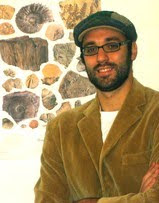
Bernardo Cesare, geologist and artist.
1.    Tell us about your scientific background.
I am a geologist, specialized in petrology (the study of rocks) and in particular in metamorphic rocks and in the origin of granites. I received a MsC (1987) ad a PhD in Earth Sciences (1992) from the University of Padova (Italy), where now I am Professor of Petrology. I've spent research periods in Zurich (Switzerland), Princeton (USA) and Clermont-Ferrand (France), and the field areas I study are in the eastern Alps, southern Spain, the Eolian islands and southern India. In the last decade I've been intensely involved in the advanced training of early stage researchers in petrology, coordinating the Marie Curie Project "Eurispet" (www.eurispet.eu).

2.    How do you describe your photographic style?

Technically speaking it is "Transmitted polarized light photomicroscopy of rocks and minerals" that translates into "photography of what you see looking down a microscope when polarized light is passed through a piece of rock or mineral". There are two essential aspects in this technique: that the light is polarized (using special lenses similar to those of many sunglasses) and that it passes through the crystals. In order to become transparent the rock must be sliced to a thickness of 30 micrometers (!).
Actually what I just described is not at all a "style" of mine, as it is the conventional way of studying rocks that all geologists adopt. My own addition to it is the search for an aesthetic image, that I generally obtain with a non-conventional use of polarizers and compensators (like the red tint 'lambda' plate), modifying the interference colors of minerals. In this way I can disclose the microscopic secrets within a stone.
In his website, Bernardo Cesare describes these 'crystal waves': "These undulating patterns are the result of deformation. Smashing, squeezing, and shearing of rocks create alignment and folding of crystals to give an idea of movement".
3.    How did you get into this vein of photography?
Photography is an essential tool for a geologist. In my case, along with being interested in outdoor, macro and reportage, I have extensively used photomicrography for research, in order to document the small-scale phenomena that I could see in rocks. Beside this scientific side, where I have got most of my training and acquired the technical rigor, I have cultivated the search for the beauty of rocks under the microscope. This 20 year-long amateur activity has recently boosted, after my images received the appreciation of audience and juries at international level, until I started the Microckscopica - Rock Art project (www.microckscopica.org).

4.    What do your photomicrographs tell about Earth? And what about Art?
My photomicrographs are taken primarily because of their aesthetic appeal: I take a picture because I like its visual impact, even if I don't know much (or anything) about the geological story of the rock. I don't know if this can be called "Art": I use to say that the artist is the rock, not me! What I do is to disclose the Art in rocks like a reporter at a Museum. Yes, I help bring to life the colors, but the shapes, textures and patterns are already there.
There's no geology in the process I just described. However, when I use rock samples that I do my own research on, the image may tell a fascinating geological tale: of continents separating or smashing into each other, of volcanos erupting with explosions, of phenomena that occur in inacessible parts of our planet, of millions or billions of years in the Earth's life. So I would conclude that images at Microckscopica may tell something about the Earth, but not necessarily.
 "These are images from rocks samples I collected in the Tauern Window, a geological region of the Alps. I took these photos to complement an exhibit of minerals from the collection of G. Gasser,
in honor of A. Bianchi and Gb. Dal Piaz, who explored the italian sector of the Tauern Window in 1920-1930" says Bernardo Cesare..

5.    Would you give a brief walk through your workflow?
Let's start from scratch, saying that I collect or get a chunk of rock I want to take nice images from. What I have to do first is to get a carefully prepared and polished "thin section": a 30 micron-thick slice of rock glued to a glass holder. The thin section has to be made by a technician with quite a sophisticated process, and the cleaner and more polished it is, the better and sharp the photo will be.
Then I look at the thin section under a camera-equipped microscope (this is also what I do for my regular research activity) and when I find a beautiful subject I take one or more photographs varying the interference colors. Digital photography has been a revolution in this stage, because I can immediately see what the picture looks like without having to wait for film processing, and can take dozens of images for free. Then, since there's almost no post-processing (see below), I check the results and store the images in my computer.

6.    How do you find your subjects?
In three ways: looking at my own samples while I am doing research; borrowing interesting thin sections from colleagues; collecting, purchasing or asking people chunks of rocks that I know are, or could be, aesthetically promising. For example, last summer I bought a beautiful necklace made with beads of "Ocean Jasper" (see below). I knew that the rock was interesting, so instead of giving the necklace to my wife as a gift, I had thin sections made from the beads.
When the thin sections are ready I browse through them until I find a good one, and I "play" with the polarisators and compensators until I obtain a nice composition.

7.    What kind of equipment do you use?
After using for several years a conventional camera with tungsten-light film for color slides, now I have a 18-mpixel Canon 550D digital reflex mounted on a Zeiss Axioscop 40 polarizing microscope.

8.    Do you post-process your photos?
In general I try to avoid any post-processing, even image cropping. This means that I like to have the "right" image colors and composition exactly within and at the 3/4 or 2/3 format of the camera, and with the chosen magnifying lens, at the time of taking the picture. After shooting, I use Photoshop only for subtle modifications of contrast and brightness.

9.    What kind of rock do you like to shoot most and why?
Well, there are many, because (as long as the thin-section is carefully prepared) almost any rock "hides a microscopic universe of colors and forms". Sedimentary rocks, especially limestones, are difficult due to the high birefringence of carbonates. Therefore I prefer to work with metamorphic and igneous rocks. If I had to choose just one, I'd say that "Ocean Jasper", a weathered spherulitic rhyolite from Madagascar, is the one that provided many beautiful subjects. It should be pointed out that although I work primarily with rocks, there are other things that provide very beautiful images with the polarized light. One of them is nylon, and you can see some images in the Microckscopica web gallery.
A rock sample coming from Kerala (see next question).
 10.    Could you share a favourite recent image and tell us a little of the back story behind it?
I like very much this image, that was taken from a rock sample coming from Kerala (India) and provided by my colleague Satish Kumar. It shows black areas interspersed between colorful patches. The black are crystals of graphite, while the colored crystals are silicates called felspars. In this region of southern India graphite is common, and can be so abundant to be economically exploited. The rock (and the graphite it contains) formed about 550 million years ago, at very high temperatures (more than 850 °C) deep in the crust. At that time India, Madagascar, Antarctica and south-east Africa were joined together as part of a supercontinent called Gondwana. This is the reason why we find very similar rocks in all these places.
The size of the rock fragment captured in this image is approximately 3.5 mm in length.

11.    What has been your most memorable award and why?
The ninth prize and one image of distinction at the Nikon Small World 2009 contest have been the most rewarding prize, because they certified that my images have reached a very high standard. From a different perspective, the request from a woman in New Jersey to use my photomicrographs as inspiration for producing artistic quilts confirmed my opinion that photomicrographs of rocks are aesthetically very appealing.
8 March, Chirignago (Venice): Microckscopica per Wamba.

12.    What will you have on display at “Microckscopica per Wamba”?
This exhibit will showcase about 25 images printed on canvas, their size ranging from 45*60 to 90*90 cm. The subjects represent a kind of "best of" selection, without a particular geographic or geological identification. Just beauty! There are sedimentary, igneous and metamorphic rocks from all over the world, including the near Venetian Prealps and the far Antarctica. The important thing of this show is that images can be purchased through a donation to the charitable Association "Insieme per Wamba" (www.insiemeperwamba.org), thereby helping to provide food, medical assistance and education to the people of Wamba, a village in Kenya.

13.    Traditional photographic printing or canvas print? Which do you prefer and how does your approach differ for each medium?
The printing technology is quickly reaching, and passing, new frontiers. Nowadays digital files can be printed on almost any kind of surface and medium, opening infinite opportunities for the use of the image and to its visual representation. I've chosen to print my images on canvas rather than on paper because in this way (and with their "abstract" subjects) they become very similar to paintings, and this enhances their effect as decorative art. This doesn't affect my approach, as the printing resolution and technique is very similar in both cases. With time I want to explore different media, such as glass or plexiglass for retroillumination (see below) or wood or metal.

14.    What projects are you currently working on?
With museum curator, Dr. Benno Baumgarten, I am preparing the next exhibition that is planned for this summer at the Museum of Natural Sciences of Bolzano. It will be entitled "Light on the Rocks", and will include about thirty large-format (50*75 cm) images from Microckscopica, printed on plexiglass and mounted as backlit panels. I hope that "Light on the Rocks" will become a traveling exhibition.

15.    What do you aspire for? What are your dreams as an artist and a geologist?
As a geologist I aspire for a better future for research in Italy: it is more and more difficult to work with enthusiasm when you see that everything falls apart.
As an "artist" one of my goals is to publish a book of Microckscopica images: a coffee table book with large-format pictures. But the "dream of dreams" is an article in National Geographic...
"Flowers in the geologic greenhouse are quite small, down to less than a millimetre, and take
up to hundreds million years to grow. But if we have the chance to get some,
they may last forever, and do not need watering or fertilizer" says Bernardo Cesare.


Monday, December 27, 2010

Coldigioco Geological Observatory: winter holidays special issue


Mountains, traditional cuisine, natural landscapes, snow-covered trees: It’s Winter Holidays time!
Placed on a tiny hilltop, the Geological Observatory of Coldigioco is the ideal place to celebrate this very special moment of the year with a touch of GeoArt. In fact the Geological Observatory of Coldigioco is an independent center for research and education in geology, art, and cuisine.
Founded by Alessandro Montanari (geologist and “geo-musician”) and Paula Metallo (artist), the Observatory provides an unique cultural and natural scenario which inspired scientists and artists worldwide.
In a recent issue of this webzine, I interviewed Alessandro and Paula. Many questions remained unanswered, among which the possible existence of a 'Coldigioco School' of GeoArt. In order to explore Coldigioco’s geoartistic environment, I talked with Paula.

How important do you think it is for artists to know about geology, and why?
I thought it was more important for Geologists to know about art. When I started teaching drawing to our Carleton university  geology students I had to first think about how to approach scientific thinkers in a way that they could learn how to draw more accurately. So I started out with the two halves of the brain and our two eyes and looking for relationships in general. Counting and measuring lines and angles, and observing with a devoted attention. I ended up realizing that this is exactly what Geologists do already in order to draw (conclusions). From then on the teaching became a complete give and take experience.
I think the most important thing Geology has made me aware of is deep time. Actually grasping millions of years instead of just hundreds or thousands gives me a lot more data to compare with and the possibility to visualize cyclicity. The other thing I really like is the "slow motion" of mountain growth. A big reason why the handmade is still important in my work is to make space for "slow" in my life. Geology helps me to cope with the idea that everything is in constant change, it brings together impermanent and enduring elements right before my eyes.

What are your experiences in “expressing geology with art”?
My work has always taken inspiration from the wish to decipher and “fix” complicated situations by searching for the underlying symmetry, harmony, and natural beauty in things. I think it was inevitable that the work would pass from investigating people to relating to the planet that hosts them. Because I consider remaining contemporary an important consideration in my work, it was inevitable that environmental issues, having now become the most pressing of situations for all life on the planet, would eek their way into my research.
For example I started out making mock thin sections like those scientists utilize for microscopic analysis. Then collaged the thin section images to other objects like the tree pies and the copper sieves.
A series titled, MIMBRES BOWLS; MAN MADE HOLES, started when I read about the Mimbres culture, which was centered near the southwest region of New Mexico. Their pottery has a hole punctured in the center indicating that the bowl was ceremoniously “killed” allowing for the spirit of the image to be free, and so symbolically replenishing the “hole” left behind in nature. This struck me as such a just and romantic idea.
I have made a series of bowls with images of some of the largest and deepest manmade holes on earth, and so classifying the damage. I accompany them with their own Mimbres bowl in an attempt to remedy the damage done.
Mimbres Bowls (picture from Paula's Saatchi page).

A particular of Mimbres Bowls.
The work was shown in conjunction with a Penrose Conference, “The Late Eocene Earth: Icehouse, Hothouse, and Impacts in Italy in 2007. And at the Rieskrater-Museum in Nördlingen, Germany until March 2010. These avenues were in some way connected to the concept of holes in the earth.
In Waiting for the next one, Paula Metallo compares geologic hazard and the moment of recognition in Italian filmmaking. Can't you recognize the scene? Watch the video below!

The trailer of Fellini's masterpiece La Strada, which inspired Paula Metallo.

I am now working on a body of work title, WAITING FOR THE NEXT ONE; (ASPETTANDO IL PROSSIMO). The history of Italian filmmaking documents and confirms the great Italian ability to re-present the real. It is stereotypical that in the face of natural and human tragedies Italians tend to dramatize. But is passively waiting, and not preparing for earthquakes, particularly Italian? And can this be explained through the story of Italian cinema?  It seems that an honest and efficient reply to the geographical and geological reality of living on shakey ground is a response not inherent to the Italian people. Are Italians somehow attached to the drama connected with tragedy? The images in this body of work ask these questions. I have chosen frames from Italian movies that seemingly catch famous Italians in the exact moment of recognition that something is about to happen. I place these images alongside more abstract images of seismic activity, interacting as a riddle.


Another artwork from Waiting for the Next one (picture from Paula's Saatchi page). With the artist's words: "I have chosen frames from Italian movies that seemingly catch famous Italians in the exact moment of recognition that something is about to happen. I place these images alongside more abstract images of geological and seismic information. Through the images, I literally put the italians face to face with a tectonic reality".


Together with Dona Jalufka, you realized a crater themed show for the Penrose geological conference (Ancona). Please, explain your emotional journey in creating “Rimanare Colpiti | Awestruck”.

We were searching for a balance between the privileges we wanted from the art world and what we were actually able to achieve. So we asked ourselves what we really had to offer, what made us particular after looking over all our life experiences, in order to apply ourselves to those places that may be looking for those particularities so that we could manage to show our work annually in less ‘invisible’ places. We thought if we took our passion for art and mixed it with our life experiences with science we would find a solid originality.
Invitation to Rimanere Colpiti / Awestruck.

This was the beginning of an art/science collaboration, which seems to me now as a challenging approach to a new kind of comparison.
The show at the Humboldt Museum für Naturkunde in Berlin titled, (un)Measuring The World, was inspired by Daniel Kehlmann's 2005 book, Measuring the World, a story of how Alexander Von Humboldt hoped to measure everything on the planet: “Whenever things were frightening,” Humboldt wrote, “it was a good idea to measure them”. The show was a meditation on the idea that there is more than one way to measure the world. This was an exhibition concentrating on integrating the artwork into the  science museum in unusual ways.


Crater themed show for the Penrose geological conference in Ancona, Italy, 2008


Paula’s words are very inspiring, but I have still many questions in my mind: How Coldigioco inspire visual arts? What is the role of geology in this process? Who are the artists revolving around Coldigioco?

The best way to answer these questions is to follow “Rimanare Colpiti | Awestruck” and chronicle the collaboration of Paula Metallo and Dona Jalufka. For this reason, I interviewed Dona Jalufka herself.


Dona, you and Paula realized Awestruck / Rimanere colpiti. Please give me some insight on your journey in making this artistic project.
 “Awestruck/Rimanere Colpiti” was a bit of a signpost for both of us. The exhibit was held in conjunction with an international conference entitled “The Late Eocene Earth: Icehouse, Hothouse, and Impacts” – organized as a Penrose Conference by the Geological Society of America and held in Monte Conero, Italy, in October 2007, and was to be the first of our art/science collaborations. The show was an expression of how we where struck by the knowledge of natural phenomena, and how we sought to provide an artistic response to the ever-increasing flood of scientific information.  We set out to generate a dialogue using art to examine new and prevailing ideas concerning science and the order they impose on our lives. Specifically focusing on geology, astronomy, climate change, and evolution, we began a comprehensive dissection of various concepts and perceptions. In essance, we became “scholars” in our studios, studying images, material, and concepts borrowed from the scientific community.
There were a significant amount of opportunities here for us to explore. For example, an imaginary crater was created by collaging two palindrome images of a postcard of the Bay of Monte Conero, in the Marche region of Italy. A small photograph of the Earth was preserved in a keepsake locket, and arranged on a table, together with other art objects, presented in a way that recalled a display case in a classic natural history museum. This image of the Earth represents the first time man saw himself far from his usual geocentric position, and constitutes an important historical moment in human visual perception. Other objects in the exhibit utilized scientific props, such as laboratory sieves, thin sections, slides, and steroscopes. Our goal: To show that imagination and reflection are common denominators between art and science.


You and Paula displayed Unmeasuring the World at the Natural History Museum in Berlin. What do you mean exactly with Unmeasuring the World?
The connectedness to both science and the creative challenges it evokes are in many ways artistic in nature. Paula and I believe that our work reflects the never ending fascination of the arts with the wonders of science. Because the Natural History Museum is a home for many disciplines, it makes it a good base for art/science cross-pollination, and allows to present the artwork in a scientific context, providing a symbol of such an interdisciplinary approach. A major influence for this exhibit was Alexander von Humboldt (the famous German naturalist, 1769-1859). His research and discoveries in all fields (from mineralogy to volcanology to biology and glaciology), and especially his approach to unifying all the aspects of the physical world, spoke volumes to us as artists. The title of the exhibit pays homage to Humboldt as well as to Daniel Kehlmann’s thoughtful book on Humboldt entitled “Measuring the World” (a phrase referring to Humboldt’s desire to measure everything in the world). It also provided us with an opportunity to compare the concepts of measuring and unmeasuring as in contrasting science with art. The word “unmeasurable” relates to “unconstrained”, “infinite”, and “untold” --- a kind of poetic version of the scientific measuring of the world that Humboldt set out to do. The year 2009 was the 150th anniversary of his death, and considering his historical influence and association with the Berlin museum led us to invoke his creative insight in our title “Unmeasuring the World”.
(Un)measuring the world: an art show by Dona Jalufka and Paula Metallo

With Paula Metallo, you realized an exhibit inside a meteorite impact crater with 14 million years of Impact Art. What was the emotional path in creating this artwork?
First of all, we were excited by the opportunity to exhibit at the Ries Crator Musem and to be able to tailor the art in such a way as to compliment their collection. Paula and I set out to explore artistic interpretations, some playful and some serious, of geological and astronomical topics related to impact cratering. The impact process can be looked at artistically from a variety of perspectives, both in terms of the medium and in terms of the interpretation. So it was only natural that our emotional paths took slightly different approaches in creating the work for this show. For me, there was a familiarity to the project, and I felt at home with it. It was exciting to have one of my art works displayed next to a piece of Moon rock!


What is one of your favorite pieces in this show and why?

Lunataler: impact geology and cheese.
I don’t normally single out certain pieces as being a “favorite”, as there were many that I felt good about once I saw them in place in the museum. The piece that I feel had the strongest relationship with impact geology and the core of the museum would have to be “Lunataler”. This piece is a playful interpretation of an old saying that the moon is made of cheese. The wedge shape is universally recognized as that of cheese, and the craters, taken from the “Lunar Orbiter Photographic Atlas of the Moon”, have been painted onto the form. Placed under a glass dome, this sculpture serves as a literal allegory for Moon cheese. Displayed in proximity to large scale lunar photographs and other impact-related exhibits, I thought it was a humorous yet thoughtful way to get people to think about craters.

Impact geology has a consistent role in your art. Why?
Oh --- that’s easy! My husband is a very prominent researcher in the international impact cratering community. To say that he has not had an influence in directing my attention to impact geology is laughable! The evidence is everywhere: antique lunar maps and crater photographs hang on our walls, there are hundreds of relevant books around, I frequently accompany him on field trips and conferences, and of course there is my exposure to planetary geology from my NASA days.

In your website you quote Cicero: “Art is born of the observation and investigation of nature”. How do you express this idea in your art?
Boundaries: geological sections in art.
The whole idea that art is born of the observation and investigation of nature is a timeless and borderless concept. Nature, being the entire natural and physical world that we inhabit, is inseparable from the inspiration and approach I take with my art. Only in examining visually and intellectually, natural phenomena and processes (in essence, taking in all of nature), am I able to make art of any kind that is meaningful.

You realized many works focused on nature and science. Which of these works do you consider “geologic”? Why?
There are a few works that I might consider purely “geological” because they deal with the Earth (for example, “Geological Evidence”, which you  mention next, and works such as “A Day in the Life of Evolution”, or the computer-altered mixed media series– e.g., “Boundaries”, “Earth Stories”, and “Fire and Ash”). There are some that take a geological process (impact cratering) and interpret them from a technical viewpoint – i.e., a series of oil paintings of atomic bomb blasts, or in the purely minimalistic approach in the triptych, “Space, Sky, Earth”, which attempts to bridge the gap from the Earth (geology) to the sky (astronomy).


You named a triptych Geological Evidence. Is it because that is how you see your artwork? Or did you mean something else?
The title of the triptych “Geological Evidence” is actually from a figure caption in the book “Biological Processes Associated with Impact Events”, edited by C. Cockell, C. Koeberl, and I. Gilmour (Springer, 2006). This particular figure of magnified thin sections of the Cretaceous-Tertiary (K/T) mass extinction boundary was very inspiring. The notion of showing evidence (in effect, proof) of a meteorite impact of this magnitude is a rather abstract concept. While this is a relatively realistic depiction of what one would see looking through a microscope, from an artistic perspective, it is pure abstract expressionism. The artwork in this case is interpreting the evidence which just happens to look like a piece of art.
In Geological Evidence, Dona Jalufka presents the Cretaceous-Tertiary mass extinction through microscopic geological proofs. As I said for Zheng Shoui's foraminiferal sculptures, geological objects extend over a wide range of scales.


You are a resident artist at the Osservatorio Geologico di Coldigioco. What is the influence of the natural environment of Coldigioco on your art?
The influence that the natural environment in Coldigioco has on my art is quite a contrast from that of the city environment. While living in Vienna with all its distractions (both positive and negative), the natural distinction between the two can be worlds apart. I find the landscape of the countryside in general, and Italy in particular, to be very inspiring. This of course benefits my landscape and abstract work just as much as the art/science work. Geology is never far away, as is astronomy (we have a small observatory in Coldigioco), and the abundance of insect and other animal life, to name a few of the natural influences that eventually (and perhaps subliminally) find there way into my art.

The triptych Space, Sky, Earth attempts to bridge the gap from the Earth (geology) to the sky (astronomy). These elements are very present in the natural landscape of Coldigioco.


What is the role of the social environment of Coldigioco on your art?
The social environment in Coldigioco per se has a certain degree of influence on my art, obviously because it is such an eclectic community in so many ways. The creativity of everything, from geology and art and to regional cooking classes, makes for a much “energized” breeding ground for my creative processes. My time spent with Paula Metallo (who resides in Coldigioco) as friend and collaborator, is enormously engaging and productive. There are constantly new things happening there involving resident Coldigiocans, visitors and students of varying backgrounds, a recording studio and vibrant music scene, rich, cultural excursions to local towns and cities, etc, etc. Whatever the venue, there is always this current of  creativity running through it. Something in the air there—the food— the wine— the people….

Coldigioco: where art meets geology! Picture from the webpage of the Geological Observatory of Coldigioco.

The words of Paula and Dona clearly expresses the vibrant artistic scenario of the Geological Observatory of Coldigioco. Within a unique social and natural environment, Coldigiocans traces shapes and colors which are continuously dancing with the Earth's interior. However, dance is often accompanied by music: at Coldigioco rock layers are singing! 
Are you surprised? Earth's sounds are coming soon, on the Geology in Art Webzine!

Monday, December 6, 2010

Coprolite time!

From the Paleolithic fossil pendant to Hannah Ingalls's wooly trilobite, geologic objects are often used as items of personal adornment. For this reason, it should sound trivial to speak - again! - of geologic fashion accessories, but this time I will tell of fecal fashion: coprolites!

Coprolites are fossil dung. They are prized objects for paleontologists as they provide direct evidence of the diet of extinct organisms and they can shed light on paleoparasitological issues.
In the late 19th century, the British geologist John Stevens Henslow understood the potential of coprolites as a source of phosphate and soon coprolites were mined on an industrial scale for their application as fertilizers.

The coprolite mining area was located in the Cambridgeshire (Eastern Britain), while the refining process was carried out by the Fison Company in Ipswich. For this reason, nowadays you find  "Coprolite street" in Ipswich!


Visualizzazione ingrandita della mappa
Click on the picture to walk around Coprolite street!

The true nature of coprolites was discovered in the 19th century by William Buckland, one of the most influential figures in the history of paleontology. Known for his eccentric habits, Buckland possessed a table made entirely of his coprolite specimens. If you think that this was his weirdest behavior, you are wrong. Indeed he had the reputation for eating everything that had a pulse, including bluebottle, panther, crocodile and the preserved heart of the French King Louis XIV.

Buckland's Coprolite Table. I have to acknowledge Chris Duffin for  precious comments on the subject. Picture from the Disillusioned Taxonomist Blog.

In William Buckland's times, nodules with coprolites at their nucleus received the name of 'beetle-stones' and they were often used as ladies' ornaments. This habit did not end with the 19th century.Indeed Artya designed 'Coprolite', a luxury watch blending art, geology and horology. With a sectioned coprolite as dial, Artya's watch transformed dung into gold.

Artya's Coprolite Watch, made of actual fossil dung.
Despite its creative timekeeping, Artya's 'Coprolite' is not the first example of the relationship between dung and time. Indeed coprolites appear in the first illustration of 'deep time', that is the concept of geological time. As early as 1830, Henry Thomas De la Beche painted "Duria Antiquior, a more ancient Dorset", inspired by the paleontologic discovers of Mary Anning.
Famed as the first scene with deep time, Duria Antiquior shows the first stage of the production of coprolites, that is... well, see the watercolor for more details.

"Duria Antiquior, a more ancient Dorset" by Henry de la Beche

In conclusion, coprolites are waste products only apparently.  Indeed, fossil dung is precious either for scientists or for artists. With the words of the 19th century author Francis Buckland:

Geopoetry: "Approach, approach, ingenuous youth, And learn this fundamental truth:The noble science of Geology is founded firmly in Coprology." Click on the image to read the whole book!

Friday, November 26, 2010

Foraminiferal Sculpture Park: a question of scales

Geological objects extend over a wide scale range: from tectonic plates to mountains, from glaciers to sand grains. Intriguingly, distant scale ranges are often interconnected and the same phenomenon can hold on very different scales. In order to explain this concept, I invite you to a relay race through orders of scale.
Variations in the Earth's orbit change the amount of solar radiation reaching the Earth. At the same time, the motion of tectonic plates reconfigures Earth's topography, consequently affecting both global and local patterns of atmosphere-ocean circulation. Plate tectonics influence also volcanic emissions (gases and particulates), which have a significant climate-controlling role.
These (and many other) elements shape the Earth's climate, including ocean temperature and marine currents, which controls the distribution of marine microorganisms.
From 150 million kilometers (Earth-Sun distance) to half a millimeter.

Some of the levels of scale dealt in the text. Left: 150 million kilometers (Earth-Sun average distance). Center: Thousands of kilometers (plate tectonics); Right: Less than one millimeter (foraminifera).

Conversely, variation in the ancient Earth's orbit can be figured out from fossils smaller than a sand grain. Likewise, microfossils are used to reconstruct past climate, ocean currents and sea depth.
One of the most important groups of microfossils are Foraminifera ('forams', for friends). They are a large group of unicellular organisms with fine strands of cytoplasm that branch and merge to form a dynamic net. They typically produce a test, or shell, which is often preserved in marine sediments.

Geologists usually study forams through a microscope and obtain information from their complex morphology. The shape of Foraminifera already captivated the artistic talent of Earnst Haeckel, who depicted several specimens in his “Artforms of Nature”.

Foraminifera  in Ernst Haeckel's Artforms of Nature.

Recently, the morphology of Foraminifera became the key point of a sculpture garden: the Foraminiferal Sculpture Park in Zhongsham, China. The Zhongsham park is the world's first park dedicated to Foraminifera. It hosts sculptures of Paleozoic to modern species, carved out of marble, granite and sandstone.
The Foraminiferal Sculpture Park of Zhongsham (China). From the website of the Cushman foundation.
A question might arise: How did the Foraminiferal Sculpture Park come to light?
The answer is given by the Cushman Foundation, one of the world's leading micropaleontological associations:
“The germ of an idea for a sculpture park first began some ten years earlier when marine geologist Bilal Haq of the National Science Foundation visited the lab of marine biologist and academician Zheng Shouyi at the Institute the Institute of Oceanology in Qingdao”
Indeed Zheng Shouyi, one of the world’s leading foraminiferalogists, sculpted palm-size models of over a hundred of Foraminifera for educational purposes. She enlarged the tridimensional morphology of microfossils by sculpture, in order to render their form – otherwise indistinguishable to the human eye.

Walking between gigant forams: this is possible at the Zhongsham Foraminiferal park! Image from Nfdaily.
A variety of the sculpted forams. Image from www.ccdu.cn.
Bilal Haq, admiring the abstract and organic beauty of these models, proposed to Zheng to enlarge the sculptures. As reported by the Cushman foundation, “Zheng, a woman of action and a politically influential scientist, took the suggestion seriously” and supervised local artisans for a period of over five years.

The result of this elaborate creative process is breath-taking: 114 permanently-sited sculptures in landscaped surroundings, covering a time span from Paleozoic to recent times. The Foraminiferal Sculpture Park in Zhongsham is an astounding celebration of biological diversity through geological time.
True Artforms of Nature, in the best Haeckel's tradition.


Interpretative structures corroborates the artistic experience. From the website of the Cushman foundation.
Art is a great opportunity for scientific entertainment and geotourism!

More micropaleontologic art. From deltabridges.com